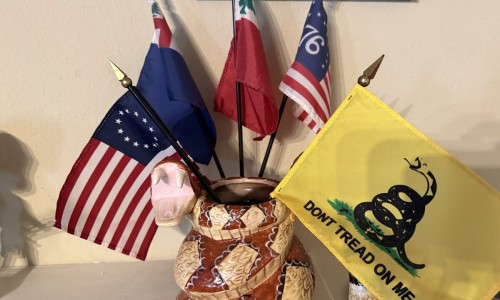
To say that beer was an integral part of the founding of the United States might still be a gross understatement.
Every moment, from the Pilgrims’ arrival at Plymouth, through the drafting & the ratification of the Constitution, and beyond, was accompanied by beer, often with the subtext of producing adequate supplies for everyone, to the extent it was often among the first questions figured out when a new colony was established [1 p8]. Water was viewed with suspicion in those days, and quickly went brackish in the hold of a ship - it was only consumed when they didn’t have any other option. Beer was seen as a healthy, restorative tonic, an idea that permeated well into the 20th century in various forms. Beer stepped up and raised a militia when the ragtag group of farmers otherwise could not be bothered to show up for drills [1 p90]. When the Sons of Liberty got together to plan their Revolutionary activities, John Hancock was always happy to fund a cask of English Ale.
To quote another great American, Hank Hill: "Is there anything beer can't do?"
Recently, I got the opportunity to help put together a beer for America 250 at the Leprechaun’s Lab, and of course, I suggest a porter. Some might recoil & say, “a dark beer in the summer?” Well, of course! It was the biggest beer style in the world at the time of the American Revolution, & was a favorite drink of George Washington!
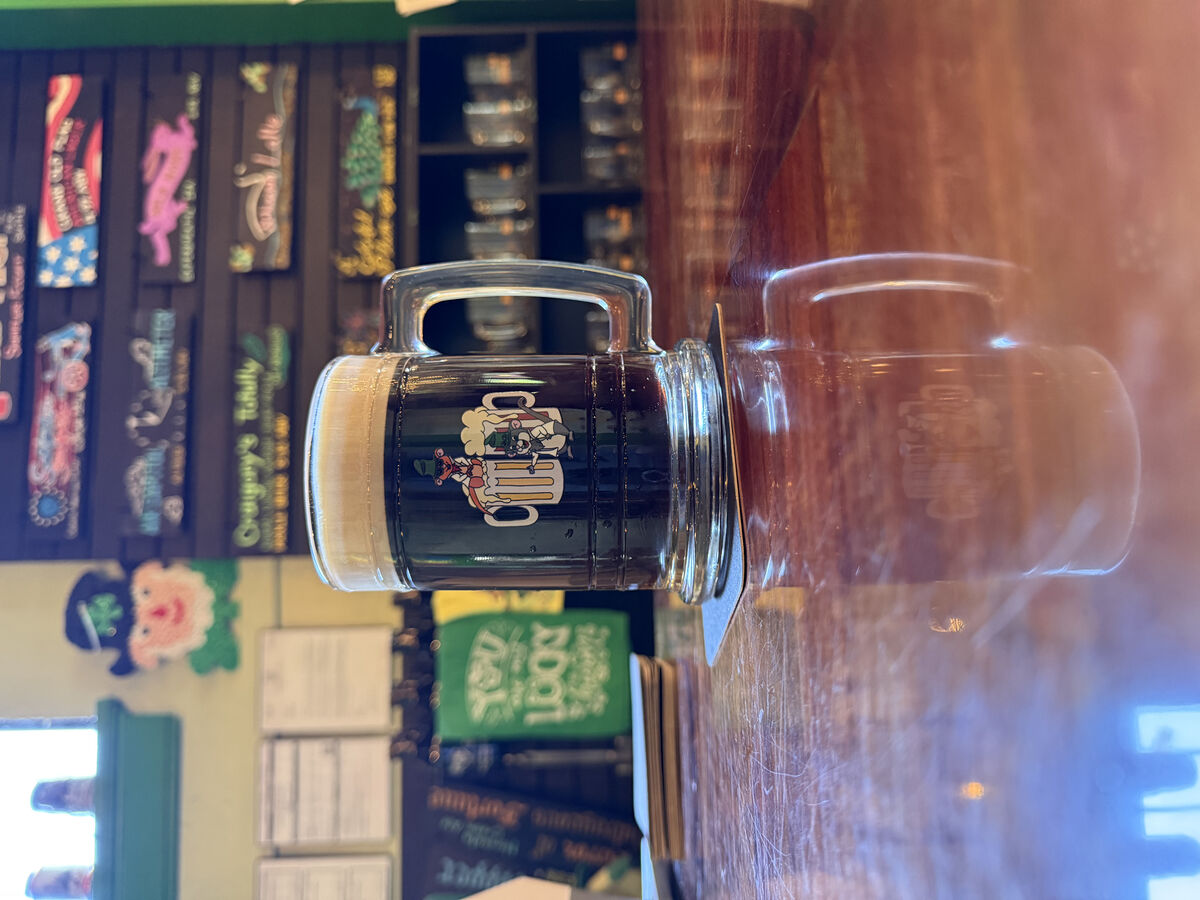
Saltpeter Stockpile Colonial American Porter at the Leprechaun's Lab, in my trusty mug number 47.
At the time of the Pilgrims, hops were a relatively new addition to English brewing, having been introduced to Kent by Dutch immigrants in the 1500's. Eventually, they broached the bulwark of traditional English ale, which did not have hops, ultimately winning the malt liquor war due to its extremely useful properties as an antimicrobial. It is this property that allowed beer to travel in good condition, and helped the British to colonize the world, as wherever colonists went, beer came with them, and locally produced beer substitutes would not be far behind - beer was a basic necessity in those days. To understand that, we need only look to the log of the Mayflower:
"We could not now take time for further search or consideration, our victuals being much spent, especially our beer." [1 p10]
Now, the Mayflower story is extra compelling to me, as I’ve known since I was a kid that I descended from Mayflower passengers, and one of them was John Alden - the cooper for the Plymouth colony, an important job given how integral beer was and how many goods in those days would spend time in a barrel. Another of his descendants, Hannah Bass, married Joseph Adams, Jr, a son of a farmer and maltster, in Braintree, Massachusetts, and their grandson, John Adams, would go on to have quite an impact on the founding of the country.
It’s amazing how much beer already integrates into the story.
And to bring it to the modern era, another Alden descendent, Drew Brosseau, founded Plymouth's aptly-named Mayflower Brewing Company in 2007! I’ll have to make a… well… Pilgrimage.
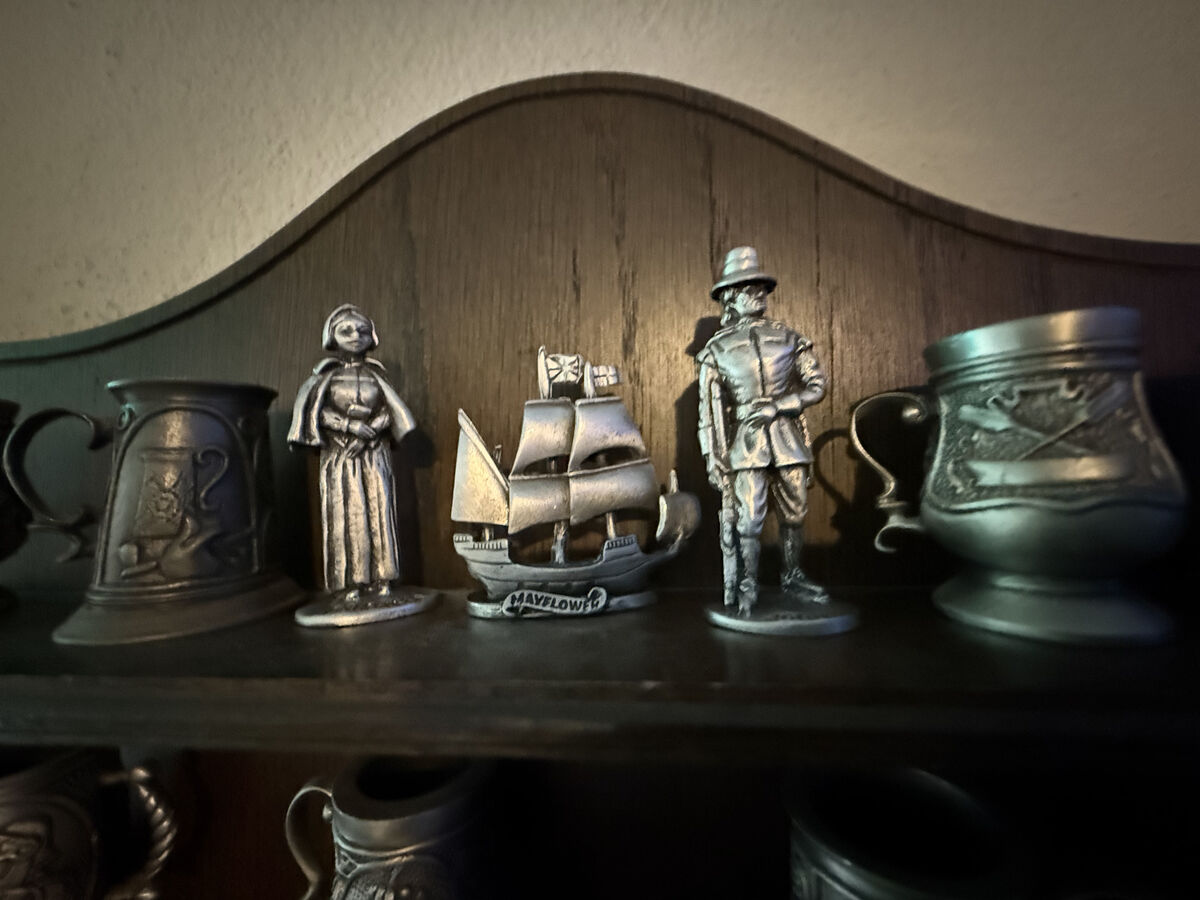
My ancestors, Priscilla Mullins & John Alden, with a mini Mayflower.
What did they brew though?
I have a saying, and this is probably as applicable a circumstance for it as ever has existed: “you gotta brew what you gotta brew”.
In their case, this meant using Indian Corn, something that had been done since the 1580's [1 p227], and malted for making beer at least since the 1620's [8], although “corn beer” dredges up imagery of mass-produced modern American Lagers. Otherwise, the name of the game was substitute ingredients - anything they could make into something halfway resembling a beer was worth the effort. This meant juicing and boiling down pumpkins [1 p68-69], drying persimmons into a cake and fermenting them [1 p229], frequent use of spruce tips as a hop substitute [1 p27], with the added benefit of protecting against scurvy due to its Vitamin C content, as well as even more use of molasses as an easy fermentable sugar source. Some of the substitutes were referenced in a poem from the 1630's:
If barley be wanting to make into malt,
We must be content and think it no fault,
For we can make liquor to sweeten our lips,
Of pumpkins, and parsnips, and walnut-tree chips.[1 p27]
Some brewers became known for spruce, birch, and sassafras beer. Ben Franklin recorded a famous recipe for spruce beer while stationed in France.
“Way of Making Beer with Essence of Spruce:
For a Cask containing 80 bottles, take one pot of Essence and 13 Pounds of Molases. – or the same amount of unrefined Loaf Sugar; mix them well together in 20 pints of hot Water: Stir together until they make a Foam, then pour it into the Cask you will then fill with Water: add a Pint of good Yeast, stir it well together and let it stand 2 or 3 Days to ferment, after which close the Cask, and after a few days it will be ready to be put into Bottles, that must be tightly corked. Leave them 10 or 12 Days in a cool Cellar, after which the Beer will be good to drink.” [2]
The pumpkins were used for a sugar source but probably produced a fairly weak beer, and reportedly it had to be aged to get the characteristic tang out of it. [1 p231] A far cry from the spiced pumpkin beer of the 2000-10s craft movement, but also with a lot in common.
George Washington had a well-documented “small beer” recipe, that I've seen often misinterpreted, perhaps its the complete dearth of commas:
“Take a large Sifter full of Bran Hops to your Taste -- Boil these 3 hours. Then strain out 30 Gall. into a Cooler put in 3 Gallons Molasses while the Beer is scalding hot or rather drain the molasses into the Cooler. Strain the Beer on it while boiling hot let this stand til it is little more than Blood warm. Then put in a quart of Yeast if the weather is very cold cover it over with a Blanket. Let it work in the Cooler 24 hours then put it into the Cask. leave the Bung open til it is almost done working -- Bottle it that day Week it was Brewed.” [3]
Beer recipes in those days were… rough to say the least, as many scientific implements brewers today depend on were on the precipice of being invented. The thermometer, and the hydrometer would be available by the end of the 18th century, but until then you’d have instructions entirely in bushels, or for commercial breweries, “quarters” of malt, which were 336 pounds, with instructions like “until blood warm” and “hops to your taste”. The establishment of the International Bittering Unit would still be about 150 years away! And the invention of the refrigerator about 100 years away. As it was critically important to life in those days, publications would give recipes and tips for homebrewing. [1 p234]
But I digress, Washington’s recipe was a “small beer” - a very light beer people drank instead of water. I’ve heard many interpretations of “Bran Hops to your taste”, clearly they were using wheat bran - a byproduct of making wheat flour, and molasses, a byproduct of sugar refining, to make “beer” with foraged hops. It’s that simple - not only that, it needed to be that simple. Any recipe using malt is very much an approximation, as I’m sure they were using the wheat bran to give it starch and body, to give the impression of a beer, and molasses to give the fermentables with some flavors. Another similar regional style is Pennsylvania Swankey - which used bran, molasses, and spices to create an every day beer. [4] Likely, they would have used barley if it were abundant, but in colonial times, it wasn’t.
Beer cocktails were also fairly common, a common one called “flip” involved heating beer in a tankard, then whipping eggs, spirits, and spices, combining them, and thrusting a red hot fireplace poker into the mixture - something every tavern had on hand in those days. [1 p210] Warm beer was seen as especially good for your health, and it is within the context of drinks like this that egg nog starts to make sense. Even more so if you consider that “nog” is suspected to be an old English dialect word for strong ale - beer was the base for cocktails in those days. Taverns would have special spice blends to differentiate themselves from the competition.
Despite the necessity of substitute ingredients, there were attempts to enact “purity laws” by the 1650’s. One such law in Massachusetts mandated the proportion of grain that had to be in a brew, in order to prevent a form of “shrinkflation”, and other laws served to protect consumers in case they purchased poor quality beer. [1 p27]
Under the Bay Colony law of 1645, ‘Every person licensed to keep an ordinary, shall always be provided with good wholesome beer of four bushels of malt to the hogshead, wich he shall not sell about two pence the ale quart, on penalty of forty shillngs and for the second offense shall lose his lecense.’ [5 p84]
So how did the war start over beer?
Beer was critically important to society in those days - a huge factor was the distrust everyone had toward the cleanliness and quality of water, leading to the all day consumption of small beer, but even factoring that in, colonial America knew how to throw them back. In the mid 1600s, Virginia reprimanded several ministers for “Drunken and riotous conduct”. [1 p65]
It turns out a lot of very important colonial American business took place in a tavern, including trials. Judges would “ride the circuit” from town to town to administer justice, something John Adams did for a while, where he seemed never to find a Tavern he didn’t like. [1 p199]
“No Taxation Without Representation” - we’ve all heard the call, usually in middle or high school history class... Usually, this meant beer, a basic necessity, and taxes over beer inflamed Colonial tempers.
The British government had gotten in a little over their heads in the 1760s - after the French and Indian War, there were considerable costs to recoup from their pyrrhic victory in North America, and across the pond they thought the Colonists should be made to pay for it. [1 p75] The big problem was they kept enacting taxes, then attempted to punish resistance with a heavy hand, leading to eventual unification and the demise of British America itself.
The first of these measures was the 1764 Sugar Act, which aimed to reform the 1733 Molasses Act by reducing the tax but increasing measures for enforcement - people were getting around the tax by getting molasses from other sources or bribing customs officials. The goal of the tax effectively was to make molasses other than from British Colonies too expensive to import, and would have threatened the rum industry if fully enforced.
Then in 1765, came the dreaded Stamp Act - requiring purchasing government stamps on all sorts of documents as a requirement to do business, including licenses for those to wanted to import and sell beer. Such acts were seen as self regulating as documents without the stamps were null and void by British law. [1 p75]
The colonists’ response was one of their first acts of resistance against the crown - the call to stop purchasing the taxed goods, letting them rot on the dock. It became fashionable to drink homebrewed beer. The fragility of the supply line was highlighted, but the poor quality of roads in Colonial America prevented shipping too much, driving colonists back to imports, which were subject to ever increasing shipping costs. [1 p69]
The stage was set for the Townshend Acts, a series of laws which gave officials of the Crown sweeping authority for search and seizure of private property in order to enforce customs laws. In addition to imposing authority on the Colonists, one of the acts aimed to punish New York for noncompliance of the Quartering Act of 1765 - the state assembly was barred from passing new laws until it complied with quartering soldiers and giving them supplies, food, and of course the most basic necessity, beer. [1 p77]
Resistance to the Townshend Acts culminated in the Boston Massacre in 1770, after some tavern-goers assembled and got a little too lit up, and started harassing some redcoats outside of the tavern. Eventually the British Government caved and repealed the Townshend Acts, except the tax on tea, aiming to show the Colonists who was still in charge. [1 p97]
Every attempt to punish the Colonists resulted in another step toward unification. The Sons of Liberty, including Samuel Adams and John Hancock, began meeting more often, fueled by the ale Hancock purchased to support their activities. It was over tankards of ale they planned the Boston Tea Party, which resulted in their unification so-called “Intolerable Acts”, the Boston Port Act closed the harbor and sealed the city in a blockade until the colony paid for the ruined cargo. This only flared the tempers of the other colonies, leading to the assembly of the First Continental Congress. [1 p85]
Unreasonable search and seizure, quartering of soldiers in peacetime… This is starting to sound familiar isn’t it? Although the latter one raises an eyebrow or two these days.
So what the heck is Saltpeter?
Saltpeter is one of the ingredients in gunpowder, and is known as potassium nitrate, along with sulfur and charcoal. In short, saltpeter is the “oxidizer” that fuels the explosive reaction. Charcoal was easy enough to make, they could trade for sulfur easy enough, but saltpeter was difficult to come by. The Continental Congress sent out pamphlets encouraging every farm in the colonies to take dirt from their barns or fields, run water through it, boil it until the characteristic white crystals of saltpeter precipitate - the word saltpeter comes from the Medieval Latin “sal petrae”, meaning salt of the rock, because it would be found on rocks. The latter word also gives us “petrified”. It was then Anglicanized into “peter”.
This call for saltpeter is immortalized in letters from John to Abigail Adams, which are referenced in the 1969 musical 1776, where their correspondence is represented with a song where John asks Abigail to organize the women of Massachusetts to produce saltpeter, and Abigail in turn wants domestic sewing pins, punctuating the extreme lack of basic supplies throughout the war. In reality, this was a massive effort, attempting to create a decentralized supply network for the Continental Army. Much, much more gunpowder came from the French West Indies, whose parent government had not yet “officially” entered the war.
Local militias were imperative for the local defense, since there would usually not be a standing army present unless they were there to fight the French. Militias would have trouble getting people to show up for drills, claiming they’d be ready to go when needed, and they had other things to do around their farms. Once they started providing beer from the local tavern, they didn’t have any trouble getting people to show up. [1 p205]
When it became apparent that war might break out, there was constant fear of the British coming for the supply of gunpowder - since without it, muskets are effectively clubs. The situation reportedly was so dire, Ben Franklin was suggesting the possibility of shooting the British with bows & arrows. The Continental Army opened the war with 80,000 pounds of gunpowder, but once guns and cannons started popping off, it went away quickly, exacerbated by rain ruining poorly-shielded supply. [7]
The fear came to fruition when the British came to seize the gunpowder supply at Concord, Massachusetts in April 1775, leading to the first shots of the war. The commander of the American forces set up his headquarters in a familiar spot - the local tavern! That's where all the important business took place in colonial times. [1 p98]
The acquisition of gunpowder was a persistent issue throughout the Revolutionary War, which would continue on until the British surrender after the Siege of Yorktown in 1781 and the subsequent Treaty of Paris in 1783, but the work was just beginning. The first attempt at a unified government, the Articles of Confederation, was found to be inadequate for a lot of purposes, so the states sent delegates to a new Constitutional Convention in 1787. James Madison arrived armed with his “Virginia Plan”, for a stronger version of a Federal government. He settled into a tavern during the convention, taking meticulous notes daily. [1 p117]
When negotiations stalled during the convention, representatives of both sides would meet at the tavern after hours to figure things out. The idea of a bicameral legislature with a “house” and “senate” was hammered out over beer at the local tavern after hours. [1 p119]
But Why Brew a Porter?
Porter, first mentioned in print in 1721, was essentially a rebranding of brown beers that already existed, then aged carefully to mimic the effects of popular blends of mild and aged beers, and compete with Pale Ales that were starting to become en vogue for the landed gentry of the day, who started moving to London more en masse in the early 18th century. Legend holds that it was named for the many carriers of goods at the London docks that liked to drink it and it became the ubiquitous drink of the English working class until it was supplanted in that role by Mild in the 1830s. [9]
By the 1770s, Porter has been around for 50 years and was being shipped around the world. We normally think of IPA as an extra hoppy beer specially designed to survive a voyage to India. While that’s mostly true, its "invention" was a lot more nuanced, as things usually are - lots of beer from small to strong were brewed and more heavily-hopped, and then sent to far away places. It was standard practice, IPA just became the best known for it in the modern era, even though Porter was shipped to India first, and for a longer period of time.
Among these places, Porter was shipped to Colonial America, where it was a favorite drink of George Washington, who imported it up until the 1770's when the colonists resisted the Townshend Acts by only home brewing and buying local beer [1 p 89]. Luckily for Washington, a brewer by the name of Robert Hare had set up shop in Philadelphia around the same time. [6 p179] Beer historian Martyn Cornell however also reported there was a Dublin-born Porter brewer producing in the mid 1760s in Virginia. [6 p178] Robert Hare’s porter would be favorite of Washington’s through the Continental Congresses and beyond, and it turns out John Adams was also quite a fan, having written to his wife Abigail about its agreeable effect on him, evidently he did not miss his customary morning tankard of Cider at this time:
”I drink no Cyder, but feast upon Phyladelphia Beer, and Porter. A Gentleman, one Mr. Hare, has lately set up in this City a Manufactory of Porter, as good as any that comes from London. I pray We may introduce it into the Massachusetts. It agrees with me, infinitely better than Punch, Wine, or Cyder, or any other Spirituous Liquor.” [10]
Even at the eve of the signing of the Constitution, George Washington, et al celebrated with extremely generous amounts of Porter, Madeira, and much, much more.
Porter Ingredients in the 1700's
It is worth noting, prior to the adoption of the hydrometer, Porter typically was made out of 100% brown malt. [11 p15] Pale malt was more expensive and the brown beer producers were using the brown malt without understanding it had quite a bit less extract efficiency. [12 p52] Brown malt in those days is not like brown malt today, and was fully capable of converting itself - this means the enzymes were preserved, and it likely wasn’t quite as dark as brown malts today.
It is widely recorded that Porters in those days required time for the acrid, burnt flavors to mellow out and become much more drinkable [11 p2] - this tends to lead people to think that they were smoky like a Rauchbier. It turns out there are some subtle differences that lead to a different experience - we must note the British were not fond of smoke flavor in their beer and always sought to avoid it. [12 p30] Brown malt for Porter in the 1700's was dried initially with a gentler fire using straw or coke (the smokeless form of coal), and then roasted at higher temperature with beechwood or oak. This differs from Rauchmalt, which is dried wet over a less intense beechwood fire, giving it the characteristic phenolic flavors. English Porter’s “smokiness” was probably a little more like that of Black Malt, but harsher, from the uneven roasting resulting in some bitter, burnt grain husks. [6 p15]
As Porter brewers began using more pale malts, maintaining the color became an issue by around 1800. Brown malt methods also changed, and a new method known as “blown malt” became the new thing - they’d dry it over an intense hard wood fire, causing it to pop, and destroying all the enzymes, but also giving maltsters the ability to produce it in four hours instead of twelve. [12 p58]
Conclusion
So as we celebrate our nation’s semiquincentennial, let us raise a glass of Porter to celebrate, and toast to good health for the next 250!
Additionally, let’s remember that it turns out: There’s nothing more American than homebrewing!
References
- Smith, Gregg. Beer in America: The Early Years - 1587-1840: Beer's Role in the Settling of America and the Birth of a Nation
- Small Beer Press: Ben Franklin's Spruce Beer
- New York Public Library: Washington's Small Beer
- Brew Your Own: Pennsylvania Swankey
- Lincoln Jones, Alvin: Under Colonial Roofs
- Cornell, Martyn: Porter & Stout: A Complete History
- RetireCoast.com: How Gunpowder Won the Revolutionary War
- Craft Beer & Brewing: brewing in colonial America
- Zythophile: The Origins of Porter and a bit about three threads
- Massachusetts Historical Society: Letter from John Adams to Abigail Adams, 29 September 1774
- Dr. John Harrison and The Durden Park Beer Club: Old British Beers & How to Make Them, 3rd Edition
- Larsen, Geoff & Daniels, Ray. Smoked Beers: History, Brewing Techniques, Recipes